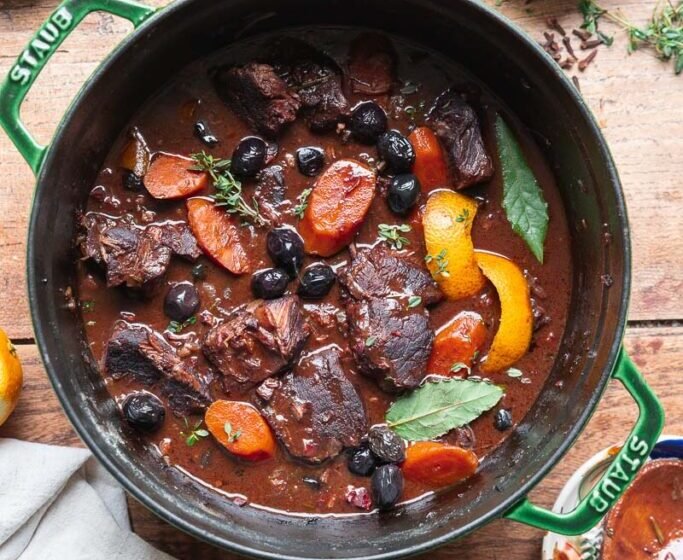

Daube provençale is often described as the South of France’s answer to beef bourguignon. The principle is the same: beef simmers slowly in red wine until it becomes meltingly tender. But here, the wine is infused with orange zest, cloves, and Nyons black olives, giving the dish a distinctly Provençal character. The recipe itself is straightforward, though a few key details make the difference between tough meat and a truly fork-tender stew.
What Is Daube Provençale?
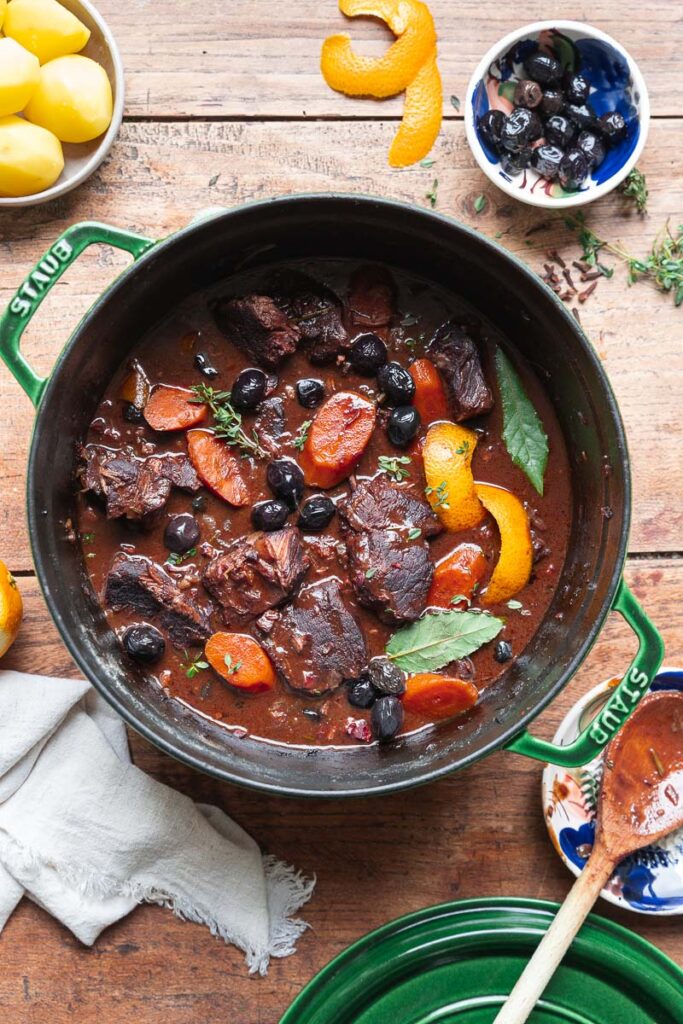
Daube provençale, also called daube de bœuf, is a beef stew that cooks gently for hours in a red wine sauce flavored with orange zest, cloves, and Nyons black olives. If you have ever made beef bourguignon, the method will feel familiar.
Traditionally, the dish was cooked in a daubière, a terracotta pot with a narrow neck that limited evaporation. Today, a cast-iron Dutch oven does the same job. Daube is also known for tasting even better the next day, so you can prepare it in advance and simply reheat it when you are ready to serve.
Daube Provençale Recipe

Type: Main course
Cuisine: French
Prep time: 20 minutes
Cook time: 4 hours 30 minutes
Total time: 4 hours 50 minutes
Servings: 6
Calories: 751 kcal
Equipment: 1 large Dutch oven
Ingredients
- 1.6 kg beef (chuck, neck, or cheek), cut into large 4–5 cm pieces
- 200 g smoked lardons
- 2 tbsp olive oil
- 2 onions, sliced
- 2 carrots, peeled and sliced into rounds
- 2 celery stalks, diced
- 4 garlic cloves, crushed
- 3 tbsp tomato paste
- 2 tbsp flour
- 75 cl full-bodied red wine, such as Côtes-du-Rhône, Bandol, or Gigondas
- 12 cl beef stock, if needed
- Zest of 1 orange, removed in wide strips with a peeler
- 5 cloves
- 1 bouquet garni (thyme, rosemary, and 2 bay leaves, tied together)
- 150 g black olives, such as Nyons olives
- Salt and pepper
Instructions
- Preheat the oven to 120°C (traditional heat).
- Cut the meat into large pieces, dry well with paper towels, and season with salt on all sides.
- In a cast-iron Dutch oven, brown the lardons over medium heat without added fat until golden, then set aside.
- Add the olive oil and sear the meat over high heat in two or three batches until well colored on all sides. Set aside with the lardons.
- Lower the heat and cook the onions, celery, and carrots for 5 minutes, then add the garlic.
- Add the tomato paste and stir for 1 minute to remove its raw taste.
- Return the meat and lardons to the pot, sprinkle with flour, and mix well to coat. Cook for 1 minute.
- Pour in the red wine, then add beef stock until the meat is almost covered—about 1 cm of meat should remain above the liquid, no more.
- Add the bouquet garni, orange zest, and cloves, then scrape the bottom of the pot to loosen the browned bits.
- Bring to a simmer on the stove, cover, and transfer to the oven for 4 to 5 hours.
- After 20 minutes, lift the lid and check that the liquid is barely simmering at the edges, never boiling. Adjust the oven temperature if needed, and stir once or twice during cooking.
- Add the olives 15 minutes before the end of cooking.
- Remove the bouquet garni, orange zest, and cloves. Taste, adjust salt and pepper, and serve with potatoes.
Notes
Storage: Daube keeps for 3 to 4 days in the refrigerator in an airtight container. You can make it the day before, and it will be even better the next day.
Reheating: Reheat over very low heat, or in the oven at 140°C for 30 minutes, without ever letting it boil.
Freezing: Freezes well for up to 3 months, but without the potatoes, which become mealy when thawed.
Nutrition (per serving)
Calories: 751 kcal | Carbohydrates: 16 g | Protein: 66 g | Fat: 35 g | Saturated fat: 10 g | Polyunsaturated fat: 4 g | Monounsaturated fat: 18 g | Trans fat: 0.05 g | Cholesterol: 187 mg | Sodium: 904 mg | Potassium: 1467 mg | Fiber: 4 g | Sugar: 5 g | Vitamin A: 3881 IU | Vitamin C: 8 mg | Calcium: 152 mg | Iron: 9 mg
Choosing the Right Meat for Daube Provençale

The cut of meat is crucial for both tender beef and a thick, coating sauce. You need cuts rich in collagen that will melt during cooking and give the sauce a glossy texture.
The classic choice is chuck, though it can be partly replaced with beef cheek. Here are the options:
- Chuck: The classic choice—fatty but not too fatty, gelatinous but not too gelatinous.
- Beef cheek: More gelatinous. Use no more than 50% of the total meat, or the sauce will become too thick.
- Shin or clod: These also work well if you cannot find the others.
- Avoid: Lean cuts like rump steak.
Tip: Cut the meat into fairly large pieces, about 4 to 5 cm, because they will shrink considerably during cooking.
The Star Ingredients: Nyons Olives, Orange, and Cloves

If you had to remember only three ingredients from this recipe, they would be these:
- Nyons olives: Small black olives with slightly wrinkled skin. If you can find them, they are ideal because they come from the region. If not, choose Kalamata or wrinkled Turkish or Greek black olives, but avoid canned black olives, which are actually dyed green olives.
- Orange zest: Remove it in wide strips with a peeler, avoiding the bitter white pith.
- Cloves: 5 to 6 are enough for 1.5 kg of meat, as they are quite strong.
Which Red Wine to Use for Daube?

The rule is always the same in cooking: choose a wine you would enjoy drinking, but you do not need to spend a fortune.
Reliable choices: Côtes-du-Rhône, Languedoc Merlot, Bandol, or Gigondas.
Grape varieties that work well: Grenache, Syrah, Malbec, Merlot, or a blend of these.
Avoid: Light, fruity wines like Gamay, which will disappear behind the meat, as well as overly old or tannic wines.
Tips for a Meltingly Tender Daube Provençale

A few final tips will help you achieve perfectly tender meat:
- Dry the meat well: Pat each piece with paper towels before salting, because wet meat will not brown properly.
- Sear in small batches: Proper searing is one of the key steps, so do it in two or three batches to keep the pot hot and get a deep brown color.
- Never let it boil: The daube should always simmer very gently; boiling makes the fibers contract and the meat tough.
- If the meat is still firm, keep cooking: It may seem counterintuitive at first, but like all slow-cooked dishes, the meat needs a long time to become tender. The longer it cooks, the more tender and melting it becomes.
What to Serve with Daube Provençale

At home, it is most often served with boiled or steamed potatoes to soak up the sauce. Other options include:
- Large chunks of potatoes, added in the last 15 minutes of cooking.
- Creamy polenta, perhaps the favorite pairing with this dish.
- Fresh pasta or gnocchi, in the Niçoise style.
- A good piece of baguette, to mop up every last drop.
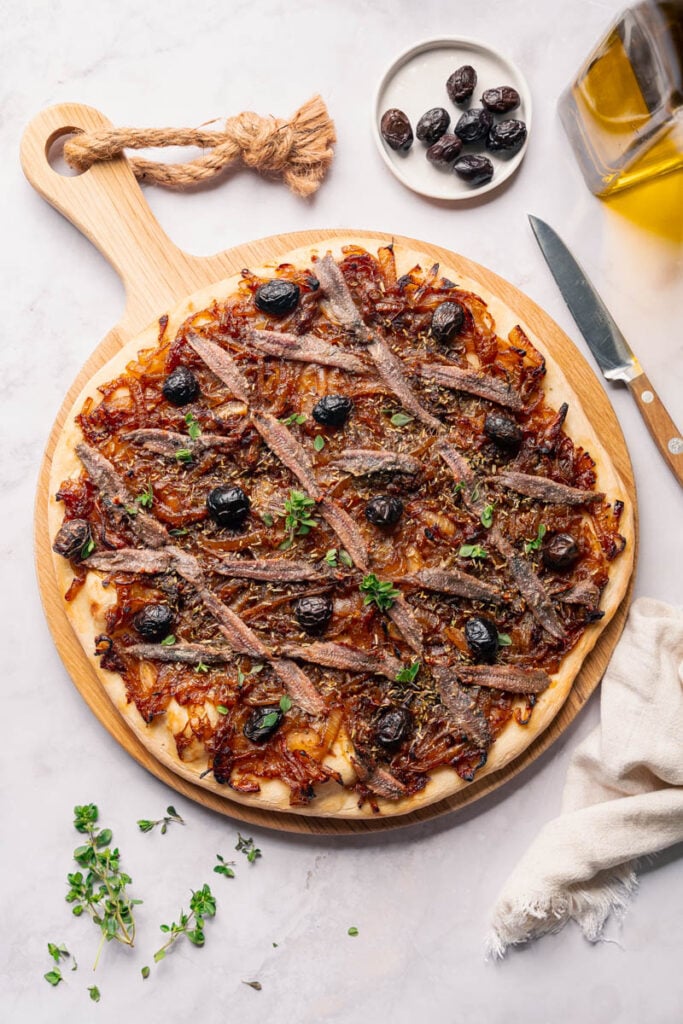
To stay in the spirit of the South, start the meal with a pissaladière cut into small pieces.
Frequently Asked Questions About Daube Provençale

What is the difference between a daube and a beef bourguignon?
Both are beef stews cooked in red wine. However, bourguignon includes mushrooms and glazed pearl onions, while daube provençale uses orange zest, cloves, and black olives.
Should the meat be marinated for daube?
In the traditional recipe, yes—the meat is marinated overnight in wine with aromatics. Personally, I do not marinate it, and I do not notice a difference in taste after five hours of cooking.
Why is my daube still tough?
It is a matter of time or temperature: either it has not cooked long enough, or it boiled instead of simmering. Return it to the oven for an hour at 120–140°C with the lid on.
Can daube provençale be prepared the day before?
Yes, and that is what I recommend, because it is better the next day. Reheat it gently, and only add the potatoes when reheating.
Can daube provençale be made in a Cookeo?
Yes, but first sear the meat in browning mode, then cook under pressure for 45 minutes. You save a lot of time, though the sauce will be less concentrated than after five hours in the oven.
What can I use instead of Nyons olives?
If you cannot find Nyons olives, look for whole, wrinkled black olives, as their wrinkles indicate they were harvested ripe from the tree. Smooth, round black olives are actually dyed green olives and have much less flavor. Kalamata olives are also a good and easy-to-find option.
More Slow-Cooked Recipes

- Beef bourguignon
- Mushroom bourguignon
- Blanquette de veau
- Braised pork with cider and apples
- Coq au vin
- Coq au vin blanc